
You sat down to work an hour ago. You’ve answered four messages, scrolled through two news notifications, helped someone find the TV remote, and refilled your coffee twice. Your actual work? Barely started.
This isn’t a willpower problem. It’s an environment problem and it’s costing the modern professional far more than they realise. Welcome to the distraction economy, where attention is the scarcest resource and almost every space around you is designed to consume it.
The Three Environments That Steal Your Focus
Before you can solve the focus problem, it helps to name it precisely. The distractions that erode your concentration aren’t random; they’re predictable, environment specific, and cumulative.
Home: The Comfort Trap
- Family interruptions and domestic requests
- Children, pets, and background noise
- Household chores in peripheral vision
- No psychological separation between work and rest
- Loneliness reducing motivation over time
- Temptation of a comfortable sofa or TV
Cafe: The Ambiance Illusion
- Unpredictable ambient noise levels
- Social anxiety around table time limits
- Slow or shared internet connections
- Uncomfortable seating causing fatigue
- Background conversations pulling attention
- No privacy for calls or sensitive work
Traditional Office: The Commute Tax
- Long, energy-draining commutes
- Open-plan layouts with ambient colleague noise
- Ad hoc meetings that fracture the day
- Poor ergonomic setups causing physical fatigue
- Rigid 9 to 5 structures misaligned with peak hours
- Office politics and social obligations
Each environment has its own distraction profile, but they share a common failure: none of them were designed primarily around your ability to think. They were designed around convenience, cost, or convention and your focus pays the price.
What the Science Actually Says
Psychologists call it context switching: the act of shifting your attention from one task to another. It sounds harmless. It is not. Research from the University of California, Irvine, found that after a single interruption, the average person takes over 23 minutes to return to the original task at full cognitive capacity. And most professionals are interrupted every three to five minutes throughout their day.
Author and computer science professor Cal Newport coined the term deep work to describe the state of focused, cognitively demanding effort that produces your best output. The problem is that deep work is extraordinarily fragile. It cannot coexist with ambient distraction. It cannot survive in a home where someone might knock on your door, a café where a blender fires up every seven minutes, or an open plan office where your colleague’s phone call becomes your soundtrack.
What Productivity Across Environments Actually Looks Like
A growing body of research on remote, hybrid, and in person work patterns reveals a consistent pattern: the quality of your output is less about how many hours you work, and more about how protected those hours are.
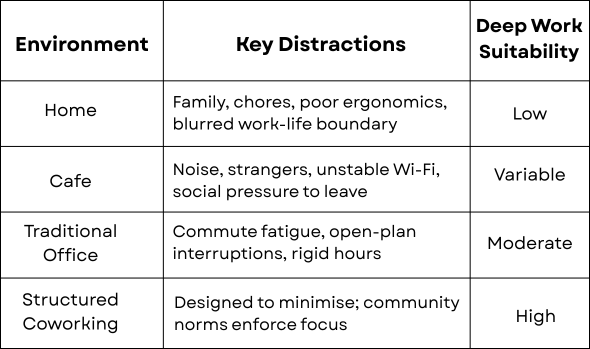
The difference between “moderate” and “high” on that table is not accidental. It is the product of deliberate environmental design and that is exactly what separates a purposeful coworking space from every other alternative.
Why Environment Design Is the Real Productivity Hack
Willpower is a finite resource. Behavioural research consistently shows that people who appear to have exceptional self-control are not fighting their impulses more often, they’re structuring their environments so those impulses arise less frequently. The high-performing writer does not resist the urge to check social media; they sit somewhere social media isn’t available. The surgeon does not “try harder” to concentrate; the operating theatre demands it.
This is the insight that most productivity advice misses. Apps, timers, and browser blockers are patches on a broken environment. The real solution is to change the environment itself.
A workspace purpose built for focus does several things simultaneously: it removes physical triggers for distraction, it signals to your brain that this is a “work mode” context through consistent environmental cues, and it creates social accountability when others around you are working quietly and seriously, the norm reinforces itself.
How GreenNest Is Built Around Your Focus
At GreenNest Business Centre in Kochi, the workspace is not a repurposed room, it is engineered for the kind of focused, high-quality work that actually moves your career and business forward.
- Structured Focus Hours (9 AM – 12 PM): Designated quiet hours where phone use moves to private zones and the floor maintains a deep work atmosphere with no loud calls, no casual interruptions.
- Designated Quiet Zones: Specific areas within the space are reserved for sustained concentration. The layout separates collaborative energy from individual focus work.
- Community Accountability: When you work alongside driven professionals and they can see you the social context itself becomes a focus mechanism. The community holds a standard, and you rise to it naturally.
- Ergonomic Environment: Proper seating, calibrated lighting, and consistent temperature mean your body is not fighting your surroundings while your mind tries to work.
- Gigabit Internet: Redundant fibre connections mean the Wi-Fi dropping is simply not something you think about. One fewer micro-stressor, one fewer context switch.
- Clean Commute: Located 600 metres from Kadavanthra Metro, the journey here is predictable and fast so you arrive with energy, not exhaustion.
Choosing Your Workspace Intentionally
The right workspace for deep work isn’t necessarily expensive or elaborate. It needs three things: consistent environmental cues that signal work mode, freedom from unpredictable interruption, and a physical setup that removes ergonomic friction from the equation.
For professionals in Kochi, whether you’re a freelancer building a client base, a remote employee working for a GCC company, or a startup founder trying to ship a product, finding a distraction-free workspace is one of the highest-leverage decisions you can make for your career. It’s not a lifestyle expense. It’s a productivity investment with measurable daily returns.
The distraction economy is real, and it profits from your fragmented attention. The antidote is just as real: a workspace engineered to give that attention back to you.
Experience distraction-free focus
Book your Focus Day Pass at GreenNest Business Centre and experience a dedicated Coworking Space in Kochi designed for professionals who take deep work seriously.
Virtual Office in Kochi for E-Commerce Sellers: Registering…
Blog Virtual Office in Kochi for E-Commerce Sellers: Registering an APOB or PPOB in Kerala If you’re already…
Virtual Office vs. Registered Office Address: What’s the…
If you're incorporating a Private Limited company in India, you'll run into this question almost immediately: do you…