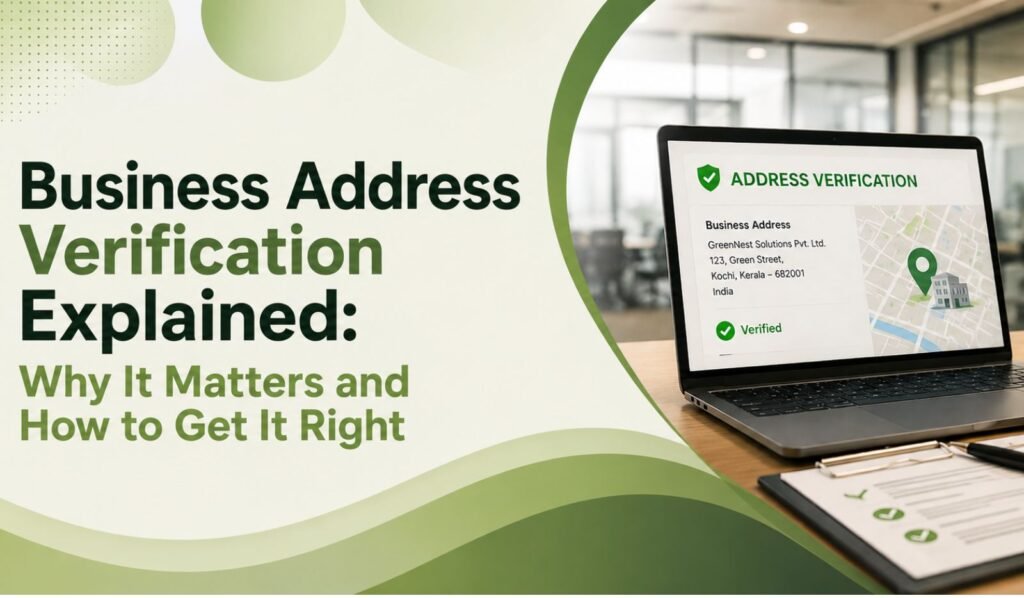
If you’ve ever tried to open a current account, register for GST, or incorporate a company in India, you’ve run into it: address verification. It’s the step that trips up more entrepreneurs than almost anything else in the registration process. A wrong document, a mismatched name board, or an address that simply can’t be “found” during a physical visit can stall your business before it even starts.
This article breaks down what address verification actually involves, how banks, GST authorities, and the Ministry of Corporate Affairs (MCA/ROC) each check it, why so many applications get rejected, and how a properly documented virtual office like the one GreenNest offers in Kadavanthra, Kochi can help you sail through every check.
What Is Business Address Verification, and Why Does It Matter?
Business address verification is the process by which a bank, government authority, or regulatory body confirms that the address you’ve listed for your company actually exists, is accessible, and is genuinely linked to your business. It’s not a formality, it’s a core part of India’s compliance and anti-fraud framework.
Institutions require this because a business address is tied to legal notices, tax jurisdiction, banking KYC norms, and regulatory oversight. If your registered address is fake, incomplete, or unverifiable, it creates risk for the bank issuing your account, the GST department assessing your tax liability, and the ROC maintaining the official record of your company. That’s why every one of these bodies has its own often overlapping verification process, and why a single weak link (like an address that can’t be confirmed) can delay or derail your registration entirely.
How Banks Verify Your Business Address
When you apply for a current account, banks don’t just take your address on paper. Most follow a layered verification process:
- Physical field visit: A bank representative or third-party verification agent visits the address to confirm it exists, matches your application, and shows visible signage or a name board for your business.
- Verification letter: Banks often send a confirmation letter to the registered address. If it bounces back as undelivered, your application can be rejected or flagged.
- Cross checking with GST registration: Many banks now cross-reference the address on your GST certificate with the address on your account opening form. Any mismatch raises a red flag.
Because of this, banks are particularly cautious about addresses that look residential, informal, or difficult to verify physically even if the paperwork looks fine on the surface.
What GST Authorities Check for Address Validity
GST registration has its own, fairly strict address verification requirements. The GST department typically checks for:
- A valid address proof document such as a rent agreement, No Objection Certificate (NOC), or ownership document for the principal place of business.
- A recent utility bill or property tax receipt confirming the address is active and traceable.
- In many cases, physical verification by a GST officer, especially if the application is flagged for scrutiny or if the business type warrants an on site check.
- Consistency between the address on the application and the address reflected in supporting documents (no typos, no outdated details, no mismatched pin codes).
GST officers are increasingly conducting site visits before approving registrations, particularly for new applicants and certain business categories. An address that can’t support a visit or one where the landlord or property owner isn’t available to confirm details is a common reason applications stall.
What MCA/ROC Checks During Company Registration
When you incorporate a company or LLP, the Ministry of Corporate Affairs (MCA) and Registrar of Companies (ROC) require proof of your registered office address within 30 days of incorporation (or at the time of filing, depending on the structure). This typically includes:
- A rent agreement or lease deed, or ownership proof if the premises are owned.
- A No Objection Certificate (NOC) from the property owner authorizing use of the address as a registered office.
- A recent utility bill (electricity, water, or similar) not older than two months, matching the address exactly.
The ROC uses this documentation to maintain the legal record of where your company can be officially contacted, and where statutory notices will be sent. Discrepancies here can lead to delays in incorporation or complications later if the address needs to be verified again for annual filings, audits, or legal correspondence.
Common Reasons Address Verification Fails
Across banks, GST, and MCA/ROC, a few issues come up again and again:
- Mismatched details between the address proof, application form, and other registration documents.
- No name board or signage at the premises, making it impossible for a field agent to confirm the business is actually operating there.
- Unavailable landlord or property owner when a NOC or confirmation is needed urgently.
- Outdated utility bills or documents that don’t meet the “recent” requirement.
- Residential addresses used for commercial registration without proper authorization, which many banks and authorities treat with extra scrutiny.
- Address not physically traceable for example, if the field agent can’t locate the unit or building during a visit.
Any one of these can result in a rejected application, a demand for resubmission, or a prolonged back and forth that delays your ability to operate, invoice, or open a bank account.
The GreenNest Advantage: A Verified Address That Passes Every Check
This is exactly the gap GreenNest is built to close. Rather than offering just a mailing address on paper, GreenNest provides a real, physically verifiable commercial address in Kadavanthra, Kochi, one that’s set up specifically to withstand the scrutiny of banks, GST officers, and ROC verification teams.
Here’s what that looks like in practice:
- A genuine commercial location: Field agents and verification teams can visit the premises and confirm it’s an active, functioning business address not a vacant lot or a residential flat repurposed on paper.
- Documentation ready on demand: GreenNest provides a signed certificate, a formal letter from management, and other supporting paperwork needed for bank KYC, GST registration, and MCA/ROC filings all prepared in advance so there’s no scrambling when an authority asks for proof.
- Visible name board: Your business name is displayed at the premises, which is often the single detail that makes or breaks a field verification visit.
- Fast response to verification inquiries: When a bank or government official reaches out to confirm your presence at the address, GreenNest’s team responds promptly, so your application doesn’t sit in limbo.
- A 100% approval track record: GreenNest’s virtual office setup has consistently passed verification with financial institutions, which means you’re not the test case the process is already proven.
For founders juggling incorporation, GST registration, and bank account opening all at once, having one address that reliably clears every checkpoint saves weeks of back and forth and repeated documentation requests.
Get It Right the First Time
Address verification doesn’t have to be the bottleneck that slows down your business launch. With the right address one that’s real, documented, and backed by responsive support you can move through bank KYC, GST registration, and MCA/ROC filing without the delays that trip up so many new businesses. Get an address that passes every verification. Start with GreenNest’s virtual office.