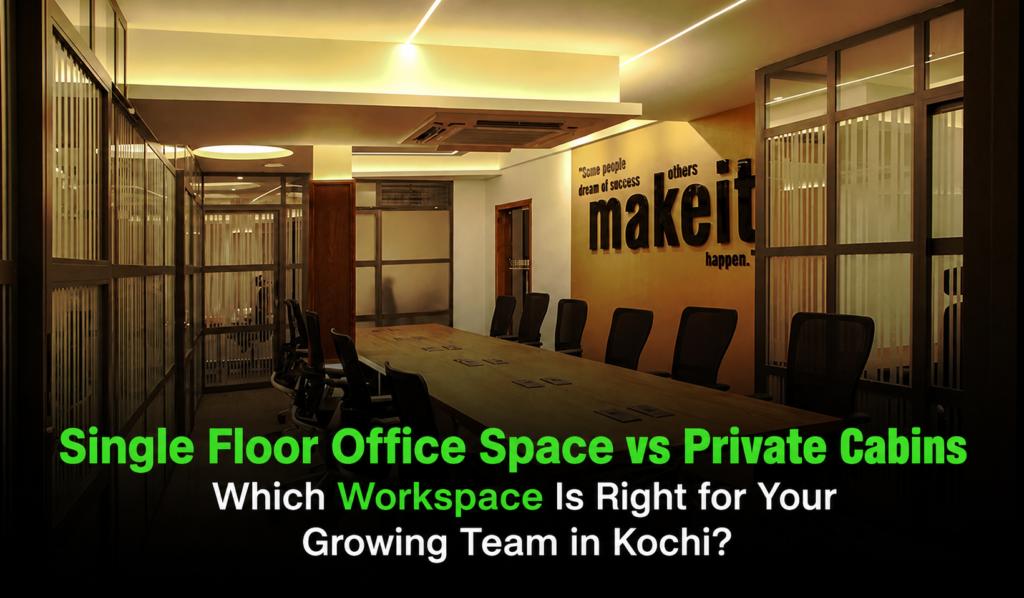
If your headcount has crossed 15-20 people, you’ve probably outgrown the “just get another cabin” conversation. The real decision in front of you now is bigger: do you consolidate onto one leased floor, or do you run your team across multiple private cabins?
At GreenNest in Kadavanthra, both are live, concrete options not hypothetical categories. You can take the entire 41-seat office space Kochi teams use when they want one self-contained floor, or you can lease one or more private office cabin Kochi units sized from 3 to 12 seats. This isn’t a theoretical comparison. It’s a decision most growing Kochi companies eventually have to make, and getting it wrong costs you either money or momentum.
Headcount and Growth Signals That Should Drive the Decision
Cabin math works cleanly up to a point. A 3 or 6 seat cabin suits a founding team or a single function. A 9- or 10-seat cabin comfortably houses one department. Once you’re combining two or three functions: sales, delivery, and support under one roof, you’re either stacking cabins side by side or looking at the whole floor.
A useful signal: if you’re already renting more than one cabin to fit everyone, or deciding between two sizes because your team sits awkwardly between them, that’s usually the point to evaluate the single floor instead of adding a third.
Growth trajectory matters as much as current headcount. A team of 18 flat for the next year is a different decision than one hiring toward 35 within two quarters. Cabins absorb small, gradual growth well. A floor suits teams that can already see the next hiring wave and don’t want to renegotiate space every quarter.
Departmental Structure: Single Function vs. Multiple Functions
This is often the clearest tie breaker. A single function team, one product squad, one delivery pod tends to work better in a cabin. Everyone’s doing related work, the noise is expected, and there’s no need to physically separate teams from each other.
The moment you have multiple functions with different rhythms engineering that needs quiet focus blocks, sales that’s on calls all day, support that’s client facing a single floor gives you room to zone the space accordingly, without one team’s normal working noise becoming another team’s daily distraction. Cabins force you to either mix functions in one room or lease separate cabins per function, which starts to resemble a mini floor anyway, just without the internal cohesion.
Confidentiality and Security: What Actually Changes
Both configurations at GreenNest include biometric access and CCTV coverage, so baseline security isn’t the differentiator. What changes is internal confidentiality.
A private cabin is a sealed room ideal if you need a single team (finance, leadership, or a client sensitive delivery pod) fully separated from the rest of your own company, not just from other businesses in the building. A single floor keeps your company together but relies on internal layout, closed manager rooms, zoned seating to protect sensitive conversations within your own team. If you’re handling client data or need to keep board level and operational discussions physically apart, that’s a layout decision to make explicitly on a floor, whereas a cabin gives you that separation by default.
Cost Structure: One Lease vs. Several
Cost isn’t just the headline number it’s how the structure behaves as you grow. Multiple cabin leases mean multiple agreements, potentially different notice periods, and pricing that scales per seat, per cabin. That’s manageable at small scale but gets administratively heavier once you’re managing three or four cabin contracts across departments.
A single floor lease consolidates that into one agreement, one notice period, one point of accountability. Exact figures for cabins or the floor are worth confirming directly with GreenNest rather than estimating but structurally, one lease is simpler to plan against than several running on different clocks.
Operational and Facility Management Differences
With cabins, GreenNest handles shared infrastructure internet, power backup, housekeeping, security but each cabin operates somewhat independently within that. Running multiple cabins means coordinating across rooms that aren’t physically connected day to day.
A single floor centralises that. Your team shares one contiguous space, one reception point for visitors, and a layout GreenNest can customise on request open workstations, private manager rooms, and a boardroom, arranged however your team works. Facility questions have one owner instead of being split across cabins.
Flexibility if You Grow or Shrink Further
Cabins are inherently easier to scale incrementally: add a cabin, drop a cabin, move to a bigger one, all without disturbing the rest of your footprint. That flexibility is real and valuable for teams whose headcount moves in smaller increments.
A floor is less granular by nature; you’re not going to give back five seats mid-lease the way you might right-size a cabin. But it offers something cabins can’t: a layout that flexes internally. You can reconfigure zones on the same floor as your departments shift, without renegotiating multiple external contracts each time.
Client Facing and Visitor Experience
This is where the two options diverge most visibly. Cabins are private and functional, but a visitor walking into a 6 or 9 seat cabin experiences your company at the scale of that room. A single floor gives you one reception point, room to host client meetings without booking external space, and a visitor experience that reflects a company operating at floor scale rather than cabin scale.
For enterprise and large-company decision makers specifically, this often matters more than the cost delta. If client visits, leadership offsites, or investor walkthroughs are a regular part of your calendar, the floor’s boardroom capable layout does work a cabin configuration wasn’t built for.
When a Hybrid Approach Makes Sense
Not every team needs to choose once and stay there. A common and sensible path: start in one or two cabins sized to your current headcount, and move to the full floor once your growth signals headcount, department count, client facing needs cross the threshold where a floor clearly serves you better. GreenNest’s cabins and the 41-seat floor sit in the same building, which makes that transition a lease change rather than a relocation.
This hybrid path is particularly relevant for startups and small teams past their first 15-20 hires who aren’t yet at enterprise scale but can already see it coming. You don’t have to commit to the floor before you need it but it helps to know at what point the cabin math stops working, so the move isn’t reactive.
Common Mistakes Companies Make Here
The most frequent mistake is under sizing out of habit staying on a second or third cabin well past the point where a floor would actually reduce complexity. The second is over committing to a floor too early, before headcount or department structure justifies it, and paying for capacity you’re not using yet.
A subtler mistake: treating this as a pure cost comparison. The right call depends as much on departmental structure, confidentiality needs, and visitor experience as it does on the lease total run the decision against all of those criteria together.
Making the Call
If your team is one function, growing gradually, and doesn’t host frequent visitors, a private cabin or a couple of them likely still fits. If you’re managing multiple functions, need internal zoning, or want one lease and one point of accountability as you scale past 20-30 people, the single floor option is worth a direct conversation.
Teams that need something in between a custom cabin configuration that doesn’t match a standard size are also worth flagging with GreenNest’s Backend Office team, who work specifically with organisations that need a layout built around their own team structure rather than a fixed size.
For a closer look at what’s included with each cabin size and the full floor, the Fully Furnished Office Space page lays out every current option at Kadavanthra. And if you’re still mapping out which stage your team is at, GreenNest is the place to start the conversation.
Whichever way you lean, the decision is easier when you’re comparing it against your own team’s actual structure headcount, departments, confidentiality needs, and visitor patterns rather than defaulting to whatever configuration you started with.