You wouldn’t run a design studio without proper lighting or a dev shop without decent monitors. Yet internet connectivity, arguably the single most business critical piece of infrastructure in a modern workspace often gets treated as a given. It isn’t. And when it fails, or simply underperforms, the cost shows up in missed deadlines, dropped calls, and quiet frustration that eats away at a team’s momentum.
How Much Speed Do You Actually Need?
The honest answer: it depends on what you do all day.
Developers pushing code, pulling large repositories, running CI/CD pipelines, or working with containerized environments need real headroom, think 100+ Mbps as a baseline. Cloning large repos, syncing Docker images, and running remote builds all lean hard on bandwidth, and a sluggish connection here doesn’t just slow you down, it stalls your entire team if you’re collaborating in real time.
Designers working with high resolution files, video assets, and cloud based design tools (Figma, Adobe Creative Cloud, video editing suites) typically need 50+ Mbps. Uploading a batch of 4K video files or syncing a large Photoshop project shouldn’t eat up your morning.
Consultants and knowledge workers people mostly living in video calls, spreadsheets, and cloud documents can often get by on 25+ Mbps, but that number gets shaky fast the moment multiple video calls, screen shares, or file syncs happen at once in a shared space.
The takeaway: these aren’t arbitrary numbers. They’re the difference between a connection that disappears into the background and one that constantly reminds you it exists.
Why It Matters More Than People Think
Video call quality: A grainy, freezing, or lagging video call doesn’t just look unprofessional, it actively damages the meeting itself. Client pitches, investor updates, and team standups all suffer when the connection can’t keep up. People remember the stutter, not the pitch.
File upload and download times: Large design files, video exports, code repositories, data sets the bigger the files your work generates, the more painfully obvious a weak connection becomes. What should take two minutes stretches into twenty.
Cloud app responsiveness: Nearly every modern workflow lives in the cloud now from project management tools to design software to entire development environments. When the connection lags, every click lags with it. That’s not a minor inconvenience; it’s friction built into every single task of the day.
Latency vs Bandwidth: Two Different Problems
Here’s something that trips a lot of people up: bandwidth and latency are not the same thing, and fixing one doesn’t fix the other.
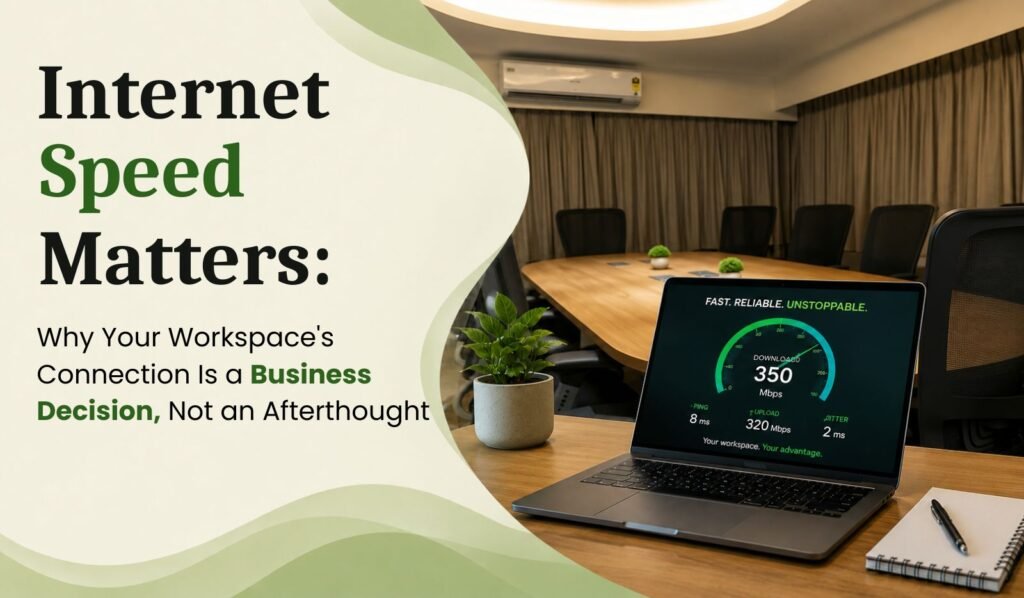
Bandwidth is about how much data can move at once; it’s why large file transfers need more of it. Latency is about how quickly a signal makes the round trip from your device to the other end and back. For video calls, real time collaboration tools, and anything interactive, latency is often the bigger culprit behind that laggy, delayed feeling even on a connection with plenty of raw speed.
You can have blazing fast bandwidth and still experience choppy video calls if latency is high. This is why simply “getting a faster plan” doesn’t always solve the actual problem. What you need is a connection engineered for both high throughput and low, consistent latency which is a matter of infrastructure quality, not just speed tier.
The Hidden Risk of a Single Connection
Most workspaces run on one internet connection. It works until it doesn’t. An outage, a fibre cut nearby, a provider side issue any of these can take an entire team offline instantly, with zero warning and no fallback.
This is the single point of failure problem, and it’s more common than most people assume. A single connection means a single point where everything can go wrong at once. Redundancy having a secondary connection ready to take over automatically is the only real insurance against this. It’s not a luxury feature; it’s basic infrastructure hygiene for any business that can’t afford to simply stop working for a few hours.
The Real Cost of Slow or Unreliable Internet
It’s tempting to think of a spotty connection as a minor annoyance. It isn’t. Do the math on what it actually costs:
- A dropped client call that has to be rescheduled damaged trust, delayed decisions.
- A developer waiting ten extra minutes for a build to sync, multiplied across a team, multiplied across a week.
- A missed submission deadline because a large file wouldn’t upload in time.
- The quiet, cumulative drain of a team working around connectivity instead of through it.
None of these show up as a single dramatic event. They show up as slow productivity leaks, the kind that are hard to point to directly but show up unmistakably in missed targets and frustrated teams.
Where GreenNest Fits
This is exactly the problem GreenNest was built to solve. Every workspace runs on a gigabit fibre connection as the primary line, paired with a fully redundant backup connection that kicks in automatically the moment it’s needed. No manual switching, no waiting on hold with an ISP, no explaining to a client why the call dropped the failover happens seamlessly, and in most cases, members never even notice it happened.
A few specifics on how this is engineered:
- Primary fibre connection at gigabit speeds: real headroom for developers, designers, and teams running demanding cloud workflows simultaneously.
- Automatic backup failover: a secondary connection stands ready at all times, switching over instantly if the primary line has any issue.
- No throttling, no sharing: bandwidth at GreenNest is dedicated, not divided up unpredictably across the building depending on how many people happen to be online.
- Infrastructure built with developers in mind: 24/7 uptime isn’t a nice to have; it’s treated as a baseline requirement, because that’s what serious technical work demands.
- No surprise costs: connectivity is factored directly into membership, not tacked on as an unpredictable add on or upsell.
The result is a workspace where the internet simply isn’t something you have to think about which, for anyone who has ever lost an hour to a dead connection mid-deadline, is exactly the point. Never lose internet again. Experience redundant gigabit connectivity at GreenNest Business Centre.