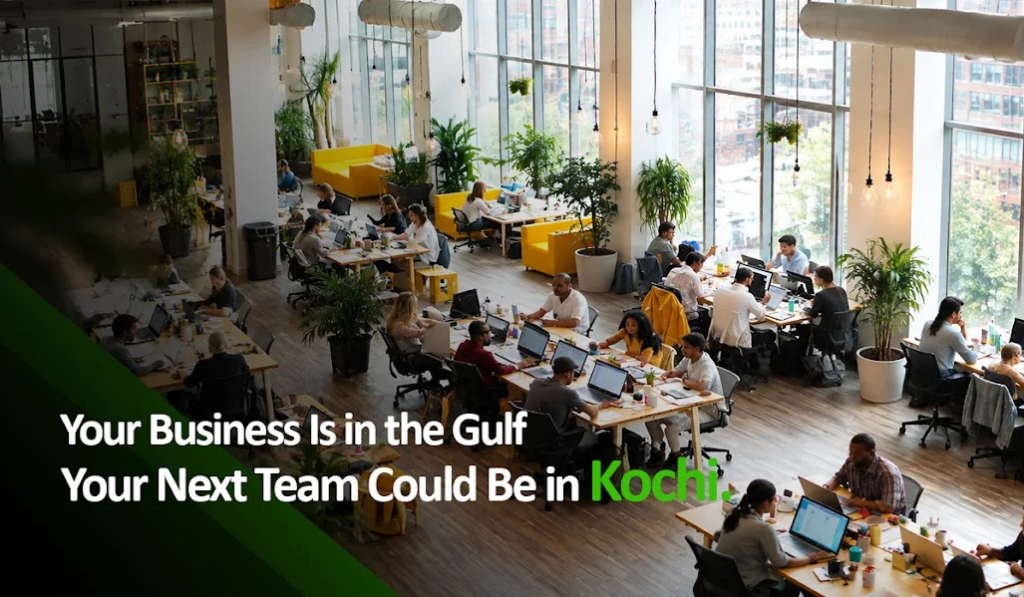
If you’re running a business out of Dubai, Abu Dhabi, Riyadh, or Doha and you’re looking at Kochi for your first India back-office, the reasons to consider it are practical, not sentimental. Here’s what actually goes into opening that first Kochi presence, and what you should know before you start.
Why Kerala, and Why Kochi Specifically
Kerala holds the highest literacy rate of any Indian state, a position confirmed across both the 2011 Census (around 94 percent) and more recent national surveys. That’s a government statistic, not a marketing line, and it’s a reasonable starting point for any business evaluating the state as a talent base. Kochi itself has built a real technology and business-services presence over the past two decades, anchored by hubs like Infopark and SmartCity Kochi, alongside strong road, rail, and metro connectivity across the city.
For a GCC-based business specifically, there’s a more practical fit too. The time difference between the Gulf and India is modest, around 1.5 hours for UAE-based teams and closer to 2.5 hours for those in Saudi Arabia or Qatar, which still leaves most of a standard working day overlapping between the two. There’s also a long-standing connection between Kerala and the Gulf: a large share of Kerala’s workforce has worked across GCC countries for decades, and that history is commonly cited as a source of mutual familiarity between the two regions, even if it isn’t something that can be measured precisely.
None of this is unique to GreenNest, it’s true of Kochi generally. What it means is that the decision to look at Kerala in the first place rests on real, checkable factors rather than only a lower price tag.
What “Opening a Back-Office” Actually Involves
This is where most of the friction shows up, and it has very little to do with your actual business. Before your team can do a single hour of productive work in a new city, someone has to negotiate a lease, handle the fit-out, set up internet and power infrastructure, deal with local vendors, and get through the compliance and registration paperwork. If you’re doing this from Dubai for a city you’ve possibly never lived in, every one of those steps takes longer and carries more risk than it would for a local business.
This is the exact gap a back-office workspace is built to close. Rather than assembling all of that yourself, you’re renting a space where it’s already been assembled: a lockable, air-conditioned private cabin, high-speed internet with backup, 24/7 power backup, and compliance documentation support layered on top. It’s worth being precise about what this is and isn’t. GreenNest is explicit that this is not outsourcing. Nobody is running your operations or providing your staff. What you’re getting is a physical environment your own team can walk into and start working in immediately, which is a different and more limited promise, but a genuinely useful one if the alternative is building that environment from nothing.
A Realistic Timeline
For a standard cabin setup, GreenNest states that a team can typically be operational within 48 to 72 hours of completing the agreement. That’s a real, first-party timeline, not a general industry claim, though it’s specifically scoped to standard cabin arrangements rather than a fully custom configuration, where the timeline depends on the scope of the work involved. If you’re planning around a specific start date for your Kochi team, that distinction matters: a straightforward 3-seat cabin move-in is a matter of days, while a larger or highly customised setup is a separate conversation with its own schedule.
Compare that to a traditional office setup in a new city, which typically runs into weeks of lease negotiation followed by however long fit-out and vendor coordination takes. This is covered in more general terms in Setting Up in Kerala, which looks at the broader Kerala market-entry picture for international and GCC companies. This article picks up from there with a Gulf-specific lens.
What This Actually Removes From Your Plate
A few things are worth naming specifically, because they’re the parts that usually cause the most anxiety for a business setting up remotely.
Space and configuration. A back-office setup starts at a 3-seater private manager cabin, priced at ₹5,500 per seat per month (₹19,470 per month all-inclusive with GST), with a 2-month security deposit and a 2-month notice period. Teams of 6 or more can work with GreenNest on a custom configuration instead of the standard cabin size, and for teams that outgrow even a larger cabin, a full-floor lease is also an option at the same location.
Documentation. GreenNest provides documentation support for company registration and GST filings, and states its address is verifiable for these purposes. If your entity setup also involves the question of a registered address specifically, Virtual Office vs. Registered Office Address covers that side of the process in more depth, and the Virtual Office service page outlines what’s included if a registered address alone, without the physical cabin, is what you need first.
Security. The cabins are lockable, the building has biometric access at the entrance and full CCTV coverage, and GreenNest states that several existing back-office clients handle sensitive financial and operational data from these spaces, which is a reasonable bar for a Gulf-based finance or professional-services team to check against their own requirements.
Meeting and client-facing needs. Back-office clients get access to both the 4-seater meeting cabin and the 12-seater conference room at standard rates, with a 20% discount for Virtual Office plan holders. If your Kochi team will regularly host calls, interviews, or client visits, it’s worth reading Meeting Rooms in Kochi alongside this article to understand exactly what that looks like day to day.
Verifying before you commit. GreenNest states that international clients are encouraged to visit in person before signing, and offers a detailed video walkthrough where an in-person visit isn’t immediately possible, which is a sensible step for any Gulf-based decision-maker who can’t easily fly out before making the call.
Where GreenNest Sits, and Why That’s Not Incidental
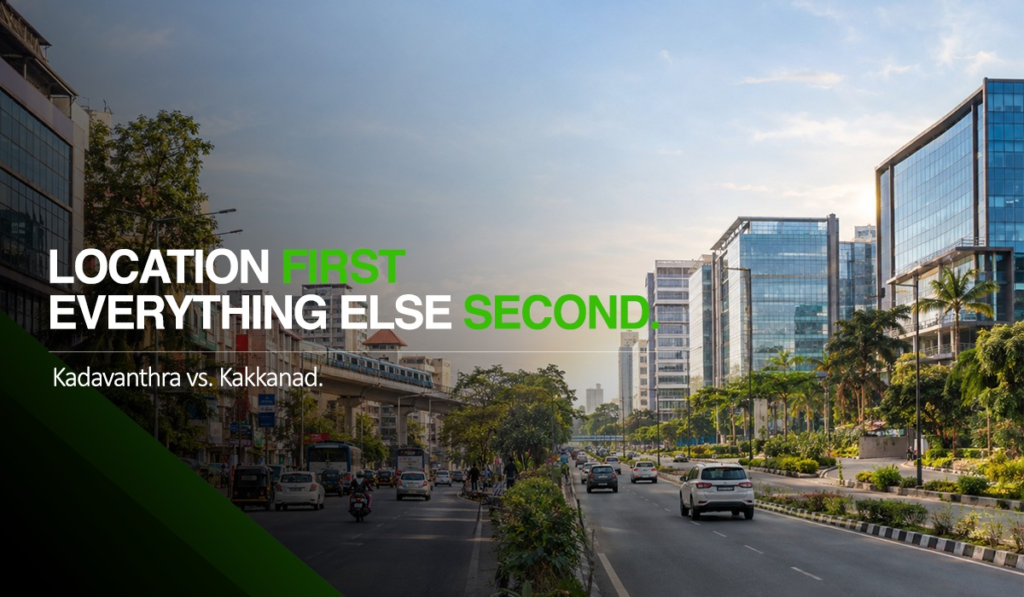
The workspace itself is 600 metres from Kadavanthra Metro Station and 1.8 kilometres from Ernakulam South Railway Station, which keeps the commute manageable for a team drawn from across the city rather than one clustered near a single IT park. The reasoning behind that location choice, and why it matters more for a team new to the city than for one that already has local habits and routes, is covered in Kadavanthra or Kakkanad? Same City. Two Very Different Commutes.
The Actual Decision
None of this removes the need to think carefully about whether Kochi is right for your business specifically. It does remove the version of the decision where you’re also trying to solve real estate, infrastructure, and compliance from scratch, from another country, before you’ve even confirmed the city is the right fit. Separating those two problems, the city decision and the setup logistics, tends to make the whole thing far less daunting than it looks from Dubai.
Considering Kochi for your GCC business’s India presence? Talk to GreenNest about your team size and timeline, or book a video walkthrough if an in-person visit isn’t possible right away.