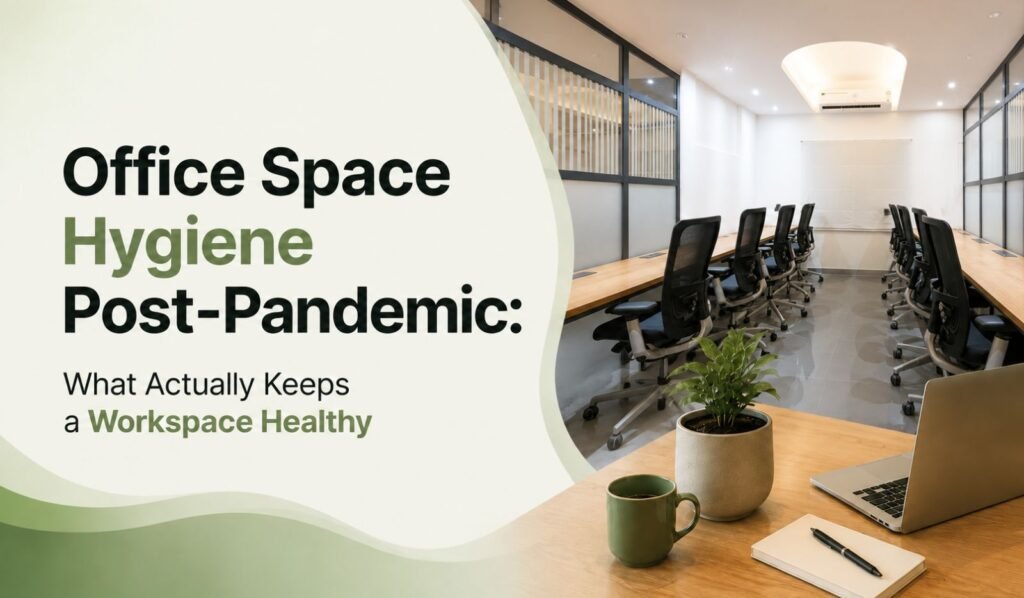
Walk into most offices today and you’ll still see the leftover habits of 2020: sanitizer dispensers bolted to every wall, laminated “cleaning schedule” sheets nobody checks, and a general sense that more spraying equals more safety. But five years on, we know a lot more about what actually protects people at work and it isn’t surface-sanitizing theater.
If you’re evaluating a coworking space or managing your own office in Kochi, here’s what the evidence says matters, what doesn’t, and how a workspace like GreenNest is built around the difference.
The Post-Pandemic Recalibration
During the height of COVID-19, offices scrubbed every doorknob hourly and fogged rooms with disinfectant between meetings. Much of that was well intentioned overkill. The World Health Organization and the International Labour Organization have since converged on a simpler, evidence based standard for workplace health: prioritize ventilation and air quality, maintain high touch surface hygiene at sensible intervals, and keep restrooms and food prep areas to a consistently high standard rather than chasing every visible surface with disinfectant around the clock.
The shift matters because resources are finite. A cleaning budget spent on theatrical, low value tasks (like re-wiping already clean conference tables every hour) is a budget not spent on the things that actually reduce illness transmission and improve day to day comfort airflow, restroom sanitation, and pantry hygiene.
What Actually Matters
High touch surfaces: Door handles, lift buttons, shared keyboards, light switches, and printer panels are touched by dozens of people a day and rarely looked at twice. These need regular, targeted attention not because they look dirty, but because they’re the actual transmission points for everything from the common cold to seasonal flu.
Air quality: This is the piece most offices still underinvest in. Poor ventilation lets airborne particles viral, bacterial, or simply stale CO2 build up over a workday, which is directly linked to fatigue, headaches, and higher sick day rates. Good air circulation, filtration, and periodic fresh air exchange do more for a healthy office than any amount of desk wiping.
Restroom hygiene: Restrooms are the single highest risk area in any shared workspace. Inconsistent cleaning here has an outsized effect on both actual hygiene and how safe people feel using the space. This is not an area to economize on.
What doesn’t matter as much: fogging empty rooms, sanitizing paper documents, or wiping surfaces no one has touched since the last cleaning pass. These practices photograph well for a “we take hygiene seriously” social post, but they don’t move the needle on health outcomes. Post-pandemic guidance is fairly consistent on this spend effort where contact actually happens.
A By Location Breakdown
Different zones of an office carry different risk levels and need different protocols.
Bathrooms: Highest priority, highest frequency. Multiple cleanings a day, with particular attention to taps, flush handles, and door hardware. Soap and paper supplies should never run dry in a restroom that’s clean but out of soap has failed its basic job.
Kitchens and pantries: The second-highest risk zone, because food contact multiplies the consequences of poor hygiene. Shared utensils, communal condiment jars, and reused cups are the classic failure points. The fix isn’t more scrubbing, it’s better systems: individual use items instead of shared ones, and surfaces cleaned after every use, not just once a day.
Desks and workstations: Lower daily risk if people mostly use their own desk, but shared or hot-desk setups need a reset between users. A daily wipe down covering desks, chairs, and shared equipment (monitors, keyboards if shared, phones) is generally sufficient more than that has diminishing returns.
Meeting rooms: High turnover, high touch. Tables, chairs, shared remote controls, and touchscreens get handled by a new group every hour or two, so these need attention between bookings, not just once a day.
Cost vs Benefit: What Cleaning Frequency Actually Works
More cleaning isn’t automatically better cleaning. The useful question isn’t “how often can we clean this?” but “how often does this surface get touched, and by how many different people?” Restrooms and kitchens, with constant multi person contact, justify multiple daily passes. Personal desks, touched mostly by one person, don’t need the same frequency. Meeting rooms sit in between cleaned between different groups, not necessarily between every individual meeting.
The offices that get this right spend their cleaning budget where contact density is highest, rather than spreading it evenly (and thinly) across every surface in the building.
How GreenNest Approaches This
At GreenNest, daily housekeeping is built into every plan; it’s not an add on or a “premium tier” feature. In practice, that means:
- Restrooms cleaned three times a day, keeping the highest risk zone consistently maintained rather than cleaned once and left.
- Desks and shared workstations wiped down daily, so hot desk and dedicated desk members alike start each day at a clean station.
- An active air circulation system, addressing the ventilation piece that most offices overlook because air quality affects focus and energy levels every single day, not just during flu season.
- Pantry standards built around individual use items, no shared utensils, disposable or personal use options by default, reducing the classic contact points that make communal kitchens risky.
- CCTV and biometric access control, which, alongside their security benefits, also mean fewer unmonitored people moving through the space and less unnecessary contact with shared entry points like keys or swipe cards changing hands.
None of this is about performing hygiene for appearances. It’s a protocol built around where contact actually happens: bathrooms, pantries, and shared surfaces with the frequency matched to the real risk at each location.
The Bottom Line
Post-pandemic offices don’t need fogging machines or hourly disinfectant rounds. They need consistent attention to the handful of things that genuinely affect health: air quality, high touch surfaces, and restroom and kitchen hygiene, maintained at a sensible daily rhythm rather than a performative one.
If you’re choosing a workspace in Kochi, it’s worth asking any provider not just whether they clean, but what they clean, how often, and why. The answer tells you a lot about whether hygiene is a real operational standard or just a marketing line.
Join a workspace that prioritizes your health. See GreenNest’s hygiene protocols and book a tour to see the space for yourself.